

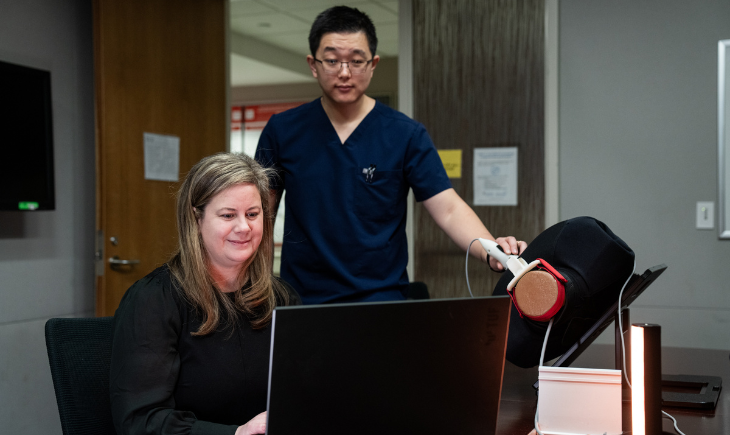
It's nearing the end of the workday at University Hospital, and a conference room has been converted into a hands-on classroom with a group of medical trainees crowding around a mannequin. But this isn’t any ordinary training session—and that’s no ordinary mannequin.
Powered by artificial intelligence, the Echo Simulator (Echo SIM) is changing the game in cardiology education. Unlike traditional approaches to training, which rely on faculty guidance and idealized scans, this high-tech tool delivers real-time feedback, allowing learners to teach themselves how to obtain accurate cardiac images.
“In traditional simulation, an expert guides you to the perfect image. Everything is centred, crystal clear, no shadows,” says Dr. Sarah Blissett, cardiologist and educator at London Health Sciences Centre (LHSC). “But real patients aren’t that straightforward. The Echo SIM mimics the unpredictability and the complexity of real life.”
Using 3D datasets of actual hearts, Echo SIM allows trainees to manipulate a probe in any direction—angle, depth or rotation—and instantly see the resulting image. It even compares their scan to an optimized version, pointing out if they’re too far left, too high or if the probe needs to be rotated. And yes, it gives this feedback all while they’re scanning.
The tool is already accelerating learning. Instead of using valuable patient time to teach basic scanning skills, trainees arrive at the bedside with hands-on experience.
“As our health-care system becomes more constrained, we don’t always have room for trial and error on real patients,” says Dr. Blissett. “This tool builds the foundation so they can focus on complex pathology when it counts.”
Today’s learners are uniquely suited to Echo SIM’s tech-forward format. With spatial skills honed through gaming and comfort in digital environments, they adapt quickly and are genuinely engaged.
“It’s very high-fidelity and lifelike,” says one trainee. “We’re used to simplified models that don’t really translate. This one does.”
Another describes the moment when things clicked: “When I moved the probe and saw how it changed the view of the heart in a 3D space, it all started to make sense. It’s made interpreting 2D images way easier.”
This isn’t just good for learners; it also strengthens LHSC’s cardiology program. By incorporating state-of-the-art tools like Echo SIM, the program raises the bar for training, draws top-tier medical talent and helps ensure patients across Southwestern Ontario receive the highest level of care.
And like most significant medical innovations, donor generosity has been key here. Echo SIM was made possible thanks to philanthropic support, with additional help from the Division of Cardiology.
“There’s no government funding for this kind of tool,” Dr. Blissett says. “Donors make these kinds of advancements possible. They’re helping us train the next generation of heart specialists, and the impact is already being felt.”
For some supporters, motivation runs deep. One donor, a former patient, insisted on helping as many learners as possible, going so far as volunteering his own heart as a teaching tool until the final days of his life. His legacy lives on in every scan, every student and every breakthrough.
For Dr. Blissett and her students, this kind of support doesn’t just advance training—it keeps the future of patient care beating stronger than ever before.