

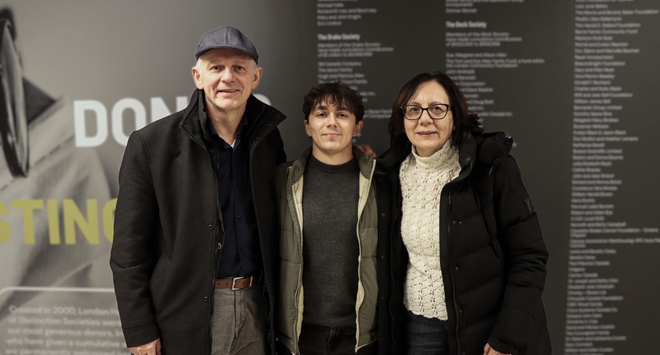
Phillip Dimitrov is currently 24 years old. The kidney keeping him alive is 58.
When he was five, he was diagnosed with Alport syndrome, a genetic condition that damages the blood vessels in the kidneys. For most of his life, Phillip had no symptoms. He was told kidney failure might come one day, but much later in life.
Instead, it began affecting him in his early 20s.
“I went to a nephrology appointment in Windsor and suddenly they were talking about dialysis and transplant,” Phillip says. “I was in disbelief.”
By May 2025, Phillip had reached end-stage renal disease. In June, he began dialysis. He was always the youngest person in the room, surrounded by patients decades older than him.
Dialysis helped stabilize his condition, but it was not meant to be permanent. Phillip needed a new kidney and didn’t know how long the wait might be. It was becoming increasingly difficult to balance his demanding treatment schedule with school.
He was referred to London Health Sciences Centre, where he began navigating the transplant process. Support came from many directions. Transplant coordinator Christy Masse was responsive, informative and caring. Social workers Erika Nieman and Heather Sadler offered guidance that made his time in London easier. Nephrologists Dr. Lakshman Gunaratnam, Dr. Dervla Connaughton and Dr. Khaled Lotfy took the time to thoroughly explain what was happening and what to expect.
Phillip’s mother, Katerina, also had Alport syndrome, which meant she could not donate. Friends and loved ones offered to see if they might be eligible. At 58, Phillip’s father Nick assumed his age might rule him out. Still, encouraged by their care team, he began the testing process. When the results came back, the family was stunned. He was a match.
The Dimitrovs then met Dr. Alp Sener, who introduced himself as Nick’s surgeon.
“After he explained the procedure with such enthusiasm and compassion, I wished he would be Phillip’s surgeon too,” Nick explains.
The family was overjoyed to later learn Dr. Sener would perform both the donor and recipient surgeries.
In the days leading up to surgery, the family experienced an unexpected act of kindness. A family in London opened their home so they could stay close to the hospital during the procedure and recovery.
On October 15, 2025, father and son arrived at the hospital before dawn and were placed in beds beside one another. Nick went into surgery first. His procedure proved more complex than expected, but the surgical team adapted. Hours later, Phillip was brought in.
Phillip woke that evening swollen and sore but overwhelmed with relief. Dr. Sener came to see him and shared the kidney had started working right away.
“He was genuinely so happy for him,” Katerina remembers. “It was amazing.”
For six days, Phillip was closely monitored by the team who celebrated every positive sign. Nick recovered quickly and was discharged in two days.
Today, Phillip has more energy. He follows a structured routine and has returned to school, studying data analytics. His parents say the change is unmistakable.
“It’s night and day,” Katerina says. “Not just physically, but mentally. He’s motivated again.”
For Phillip, the experience has reshaped how he sees the future.
“It feels like a second chance,” he says. “I don’t want to waste it.”
That sense of gratitude led the family to support Dr. Sener’s transplant research. They want to help advance the work that continues to improve outcomes for others.