

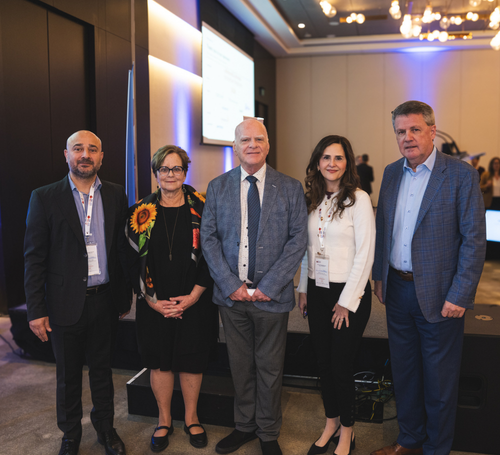
London, ON — An anonymous $6-million gift to London Health Sciences Foundation (LHSF) will help establish Canada’s first-ever national biobank dedicated exclusively to myeloma research. The ‘Canadian Myeloma Research Biobank’ will be housed at London Health Sciences Centre Research Institute (LHSCRI) and is made possible through a collaboration between LHSF, LHSCRI and the Canadian Myeloma Research Group (CMRG).
The gift ranks among the largest donations to multiple myeloma research nationally and is the largest known gift from a Canadian philanthropist dedicated to this area.
This partnership between LHSF and CMRG marks a significant advancement in cancer research and will help accelerate discoveries, improve diagnostics and expand treatment options for patients not only in London but across the country.
Together, LHSF, CMRG and LHSCRI are bringing philanthropic support, a national network of myeloma researchers and leading research infrastructure together to advance discovery and improve care. The biobank will be an ongoing collaboration between CMRG and LHSCRI, leveraging their respective expertise, research networks and infrastructure to support sample collection and enable collaborative studies that advance multiple myeloma research across Canada.
“As someone living with multiple myeloma who has successfully received treatment through an immunotherapy clinical trial in Boston, I have seen the advances being made in treating this disease,” says the donor. “I also know the cost and frequent travel required to access these treatments can put them out of reach for many Canadians. I am proud to support this foundational effort to establish Canada’s first national multiple myeloma biobank and strengthen research here at home as we work toward a cure.”
The biobank will bring myeloma samples together in one place, using consistent methods to collect, store and analyze them. This will give researchers across Canada access to the high-quality samples they need to help advance treatment and care. With patient consent, blood, bone marrow and other biological samples will be collected and securely stored for approved research, with safeguards in place to protect patient privacy. By creating a unified national resource, the biobank will address a longstanding gap in Canada's research infrastructure and strengthen LHSC's role in myeloma research.
Multiple myeloma is an aggressive and complex blood cancer that originates in plasma cells, which are a type of white blood cell responsible for producing antibodies. Cancerous plasma cells can accumulate in the bone marrow, leading to bone damage, anemia, kidney dysfunction and a compromised immune system. An estimated 4,400 people in Canada will be diagnosed with multiple myeloma in 2026.1
While treatments including targeted therapy, chemotherapy, stem cell transplantation and immunotherapy can help control the disease, there is currently no cure, and some patients face limited options when frontline treatments stop working. Until now, myeloma samples in Canada have typically been collected for individual studies or at specific hospitals, limiting access for broader research. The biobank will make samples from across the country available through a shared national resource, supporting greater collaboration and future discoveries.
“This $6 million investment to create the Canadian Myeloma Research Biobank represents a defining moment for myeloma research in Canada,” says Engin Gul, chief executive officer of CMRG. “It will expand access to high-quality biological samples and associated clinical data, enable deeper collaboration among researchers nationwide and accelerate the discovery of more precise and effective treatments. Most importantly, it brings renewed hope to patients and families affected by multiple myeloma and moves us closer to our ultimate goal: a cure.”
The biobank will complement CMRG's national database, which contains disease-specific information on more than 12,000 Canadian myeloma patients. By linking biological samples with clinical data, researchers will be able to study the disease in greater depth and explore new questions about its treatment.
“Establishing this biobank at LHSCRI will give researchers new opportunities to better understand multiple myeloma and how it changes over time,” says Dr. Chris McIntyre, interim vice-president of research and scientific director of LHSCRI. “Studying patient samples will help researchers gain valuable insights into why some treatments work better for certain patients than others. This knowledge could lead to new discoveries and ultimately, help improve treatment and care for patients.”
The biobank, while based at LHSCRI in London, Ontario, will allow researchers from across the country to study patient samples collected at different points in the course of the disease, including diagnosis, following treatment and relapse. These samples can help researchers investigate the genes and mutations associated with myeloma, how the immune system responds to the disease and how myeloma develops resistance to treatment. Samples collected today could also help answer new research questions as technology advances.
“This extraordinary gift is a powerful example of what philanthropy can make possible,” says John H. MacFarlane, president and CEO, LHSF. “As one of the largest donations to multiple myeloma research in Canada, it demonstrates an incredible commitment to advancing research and creating new possibilities for patients facing this complex disease. We are deeply grateful for this donor's vision and generosity, and for their dedication to making an impact for patients across the country.”
Planning and implementation of the biobank are underway, with the biobank expected to become operational in 2027. CMRG and LHSCRI are establishing the infrastructure and processes needed to collect, store and share patient samples with approved researchers across Canada.
By bringing together a larger, more diverse collection of patient samples and clinical information, the biobank will support national and international research collaboration, helping researchers investigate early detection, personalized treatments and other approaches to improving patient outcomes. Access to these samples could also reduce the time needed to conduct studies and advance promising discoveries.
Through collaboration with hospitals and research centres across Canada, the biobank will help advance myeloma research and bring new possibilities for better treatments and care to patients nationwide.