

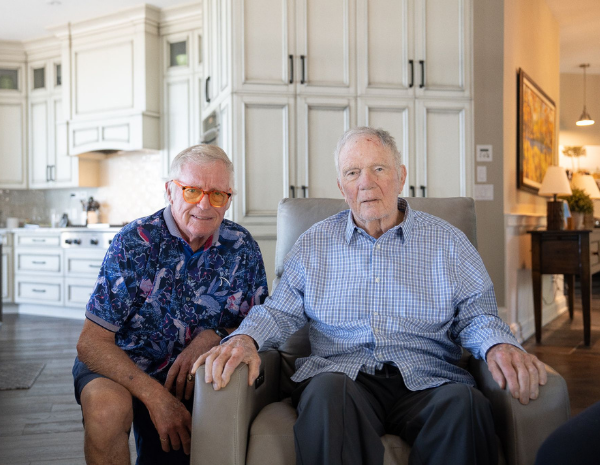
One evening, retired entrepreneur Craig Combe picked up the phone and called Dr. David Palma, a radiation oncologist at London Health Sciences Centre (LHSC). He wanted to help. There was an urgency in Craig's voice, something signalling this mattered.
Craig is the kind of person who doesn’t leave you guessing where he stands. Outgoing, quick with a joke and driven by a clear sense of purpose, he has spent a lifetime turning ideas into action. So, when he decided there was an opportunity to improve cancer care in Southwestern Ontario, he wasted little time.
“I’d like to talk to my friend, Ken, too,” Craig said. “I think he’d like to help as well.”
Craig’s friend is Ken MacMaster, previous owner and long-time leader of MacMaster Chevrolet Cadillac Buick GMC, a family-owned and operated dealership and a dedicated supporter of London Health Sciences Foundation (LHSF).
Together with his wife, Barb, and their family, Ken has quietly built a reputation for generosity, kindness and an unwavering commitment to the community. They’re the kind of people who help because they can; the kind who take your hand in both of theirs and greet you with a warm sincerity in their eyes.
Lifelong friends, Craig and Ken forged their friendship out on the links. Between birdies, bogies and the odd slice here or there (but what are mulligans good for, after all?), they bonded over a mutual respect for business, as well as a shared, natural compassion and a desire to improve the world around them. That desire has now culminated in a transformational $2.4-million gift to LHSF in support of advanced software for LHSC’s fleet of linear accelerators (LINACs)—technology that will further enhance clinicians’ ability to deliver radiation treatments with extraordinary precision. Two families coming together to help other families.
"Technology doesn't replace clinical expertise, it amplifies it,” Palma explains. “The more information we have and the more precisely we can deliver treatment, the better equipped we are to make informed decisions for each patient."
It was precisely that combination of innovation and know-how that resonated with the Combe and MacMaster families. For them, the gift wasn't simply about funding new technology—it was about giving exceptional clinicians every possible advantage in the fight against cancer.
“I wanted to see this advanced way of treating people brought to London,” Craig says. “Our physicians already have the expertise, but this helps ensure they have the tools to match.”
Like his friend, Ken’s decision was equally straightforward.
“I took it in my heart to help people if I could,” Ken adds. “If we can eliminate some suffering or grief for families, then it’ll be worth it.”
Over the years, Craig and Ken’s shared commitment has included serving on the Foundation’s past campaign cabinet during one of the most successful health-care fundraising campaigns in Southwestern Ontario.
“I have known Ken and Craig and their families for a long time and they have continually stepped up to support our hospital,” says John H. MacFarlane, president and CEO of LHSF. “This gift is the latest display of their philanthropic leadership and dedication to improving care for our community.”
Craig views giving back simply as a way to help where he can.
“I think the whole reason we were successful in life was so that we could do a bit of good in the world,” he reflects.
Dr. Palma says this is what makes philanthropy so remarkable.
“Donors are a unique group of people,” he says. “They could choose to do anything else with their hard-earned money, but instead they choose to invest in total strangers. They choose hope.”
Radiation oncologists have tried for a long time to deliver powerful doses of radiation to cancer while minimizing exposure to surrounding healthy tissue. Dr. Stewart Gaede, Chief Medical Physicist at LHSC’s Verspeeten Family Cancer Centre (VFCC), recalls how one of his mentors compared the challenge to treating only the yolk inside an egg while leaving the white and shell unharmed.
“That’s the level of precision we’re striving for,” he explains.
Advances in imaging, computing power and treatment-planning software have helped move radiation therapy closer to that ideal, allowing clinicians to target tumours with increasing accuracy and better protect healthy organs and tissue nearby.
Craig and Ken's gift not only supported the purchase of an advanced, AI-driven linear accelerator known as the Varian Ethos therapy system but will also introduce two specific types of software to LHSC's LINACs: AlignRT radiation therapy platform and HyperSight imaging system. Together, these new technologies help transform countless calculations and clinical decisions into a treatment plan tailored to each individual patient, allowing care teams to visualize tumours in real time, adapt treatment as anatomy changes.
For decades, linear accelerators have been used in the treatment of all solid tumours, including prostate, bladder and lung cancers, as well as some blood cancers. The greater precision made possible by these technology upgrades can help reduce unnecessary radiation exposure to healthy tissue, giving clinicians another opportunity to minimize side effects while delivering highly effective care. Hypersight gives a sharper, faster picture of the patient on the machine for clearer visualization of the tumour and nearby organs. AlignRT can continuously monitor a patient's position throughout treatment, improving accuracy and, for many patients, eliminating the need for the small permanent tattoos that have traditionally helped guide radiation therapy—a lasting reminder of one of life's most difficult chapters.
For the roughly 300 patients who depend on these machines each day, the greatest advancement isn't the software itself. It's what happens when cutting-edge technology meets clinical expertise.
“This technology in the cancer world is really important—shrinking tumours, saving more lives,” Craig says. “It's effective treatment for what might be the worst diagnosis you can get."
For Dr. Gaede, a self-described “tech nerd,” these are the kinds of innovations that keep the field moving forward.
“Donations like this allow physicians and researchers to dream,” he says.
Those dreams are rooted in something profoundly practical. Every improvement in precision means another opportunity to spare healthy tissue. Every advancement in imaging means another opportunity to adapt treatment to the patient standing in front of you. Every technological leap gives clinicians another chance to improve outcomes and, ultimately, quality of life.
For Craig and Ken, that was exactly the point. Neither was interested in technology for technology’s sake. They wanted to help place better tools in the hands of the people using them every day. To help physicians treat cancer more effectively, help patients spend less time living with uncertainty and help more families experience hope instead of heartbreak.
"If we can help give patients even greater peace of mind during one of the most difficult times in their lives, that's worth investing in," Craig says with stoic optimism.
New technologies are transforming the way clinicians treat cancer. But breakthroughs like this one don't happen through innovation alone—they happen because people like Craig and Ken choose to invest in possibility. They choose hope.