

Every breakthrough in cancer care begins with a question.
What if we could detect cancer sooner? What if we could predict which treatment would work best for each patient? What if we could stop cancer before it takes hold?
Finding those answers takes more than brilliant ideas. It requires time, collaboration and the freedom to pursue discoveries that may one day change lives.
This promise lies at the heart of two inaugural Chair positions established at the Verspeeten Family Cancer Centre (VFCC). Made possible through the generosity of the late Archie and Irene Verspeeten and matched by Western University, the Verspeeten Chair in Oncology and the Verspeeten Chair in Translational Cancer Research are creating far more than individual research programs. Together, they are cultivating an environment where innovation can flourish for years to come.
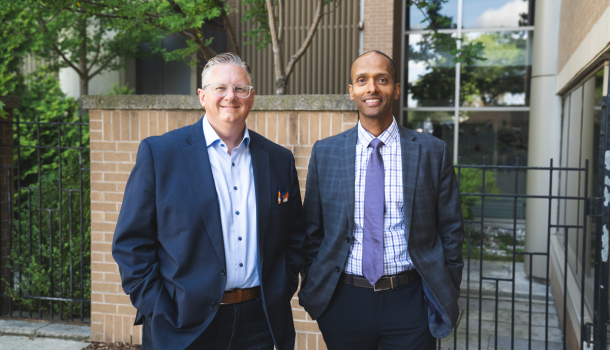
For Dr. Michael Ott, Chair and Department Head of Oncology at London Health Sciences Centre (LHSC), St. Joseph's Health Care London and Western University's Schulich School of Medicine & Dentistry, the greatest impact isn't the title itself—it's what being the Verspeeten Chair in Oncology will help facilitate.
"Research can’t happen off the corner of someone's desk," he says. "You need to give people the room to spend large chunks of their time doing that work."
Balancing patient care with research is a constant challenge for clinician-scientists. Without dedicated support, research competes with clinical responsibilities, grant applications and countless other demands. Endowed Chairs change that equation by providing stability, allowing researchers to focus on bold questions, build strong teams and pursue discoveries that might otherwise never leave the laboratory.
The stability is equally meaningful to Dr. Samuel Asfaha, inaugural Verspeeten Chair in Translational Cancer Research.
"It's an honour," he says. "It provides security in funding for us, which, in the current landscape of health-care research in Canada, is a huge thing. It also allows us to pursue high-risk projects that may have high rewards that we wouldn't otherwise be able to carry out."
Those ambitious ideas often have the potential to become tomorrow's standard of care.
Dr. Asfaha's laboratory focuses on growing tiny, patient-derived organoids—miniature versions of tumours created from a patient's own cells. These models allow researchers to better understand how cancers develop, explore why some tumours respond to treatment while others do not and, ultimately, move closer to truly personalized cancer care.
Today, this approach remains largely within the research setting. But tomorrow, it could give physicians a way to identify which therapies are most likely to benefit an individual patient before treatment even begins.
"Our hope is that we'll be able to use this platform to better understand disease, identify new therapies and eventually predict which treatments will work best for each patient," says Dr. Asfaha.
And although their research programs differ, Dr. Ott sees both Chairs as part of something much larger. Because rather than creating isolated laboratories focused on individual cancers, the vision is to build interconnected areas of expertise spanning multiple diseases. Techniques developed in one field can accelerate discoveries in another, bringing researchers together around shared approaches and shortening the path from laboratory bench to patient bedside.
"It's really about building communities of research," Dr. Ott says. "The outputs will be far greater than the input."
The impact extends well beyond individual laboratories. The Chairs strengthen partnerships between LHSC, the London Health Sciences Centre Research Institute (LHSCRI) and Western University, attract exceptional researchers and create opportunities for future scientists to train and build their careers in London. For Dr. Ott, who also serves as Interim Vice Chair of LHSC’s Medical Advisory Committee, that broader institutional impact is an important part of the vision.
But philanthropy does more than fund today's research. It creates the conditions for future discoveries.
Dr. Ott hopes the impact of these inaugural Chairs will continue multiplying for decades. As new researchers arrive, collaborations deepen and fresh ideas emerge, today's investment will continue generating tomorrow's breakthroughs.
"It's kind of like planting a seed in your garden," he says. "It takes a lot of work to grow a plant all the way from seed. But with enough care and patience it will grow, and eventually it will drop other seeds to flourish, making the garden bigger and healthier and more robust."
For patients, those seeds represent hope.
Hope for earlier detection. Hope for treatments tailored to the unique biology of each person's cancer. Hope discoveries made in London will improve care not only for local families, but for patients across Canada and around the world.
For the community, these Chairs represent something equally powerful: the knowledge that a single act of philanthropy can continue creating opportunities long after the original gift has been made.
Some investments fund a single project. Others can shape the very future of care. The Verspeeten Chairs are poised to do exactly that.