

For 75 years, London has been pushing radiation therapy forward. Today, philanthropy is helping clinicians take the next step.
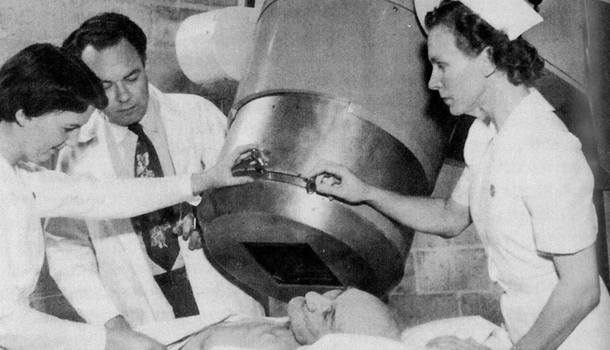
In 1951, a machine arrived in London that would change what was possible in cancer care. Known as the Cobalt-60 radiation therapy machine—colloquially named the Cobalt Bomb—was among the earliest of its kind, using a radioactive source to generate higher-energy radiation capable of reaching tumours deep inside the body. At a time when treatment options were limited, this represented a world-first in the fight against cancer.
Before Cobalt-60, the lower-energy X-rays available for external radiation therapy delivered a disproportionate amount of radiation to the skin before reaching a tumour deeper in the body. In some cases, treatment needed to stop before enough radiation even reached the cancer.
This is how the Cobalt Bomb blew open the possibilities for cancer treatment.
Because for the first time, physicians could more effectively treat cancers throughout the body while reducing the amount of radiation affecting the skin. The result was not only a more sophisticated machine; it changed what physicians could achieve for their patients.
“It opened the possibility of treating cancers in any location inside of the body,” says Dr. David D’Souza, a radiation oncologist at London Health Sciences Centre (LHSC).
It was a pivotal moment in radiation oncology—and one that helped establish London as a place where innovation in cancer care could take root.
75 years later, the technology has changed almost beyond recognition. The ambition has not.
Today, linear accelerators, or LINACs, deliver highly targeted radiation treatments using advanced imaging, computing and treatment-planning technology. Instead of simply asking whether a tumour can be treated, clinicians can ask a much more precise question: How can we deliver the treatment as accurately as possible while protecting everything around it?
That distinction matters.
Modern radiation therapy can account for changes in a patient's anatomy, movement during treatment and even how a tumour responds as treatment progresses. The goal is to deliver the radiation where it is needed and spare as much healthy tissue as possible.
It is an evolution Dr. D’Souza sees as a natural continuation of what began with Cobalt-60.
“If you think of when people went from walking to the horse carriage, it seemed great at the time,” he says. “But then when you look at a car compared to a horse carriage, there's a huge difference as well.”
The same is true, he says, of radiation therapy.
More than a machine
Today’s LINACs are extraordinarily capable. But the machine itself is only part of the equation.
Advanced technologies can make these systems even more precise, efficient and responsive to the patient being treated.
This is where philanthropy plays a critical role.
Provincial funding provides the essential equipment needed to deliver radiation therapy. But, as Dr. D’Souza explains, that funding is much like purchasing the base model of a car. Philanthropy helps equip those machines with advanced capabilities—the equivalent of vehicle upgrades—giving clinicians greater confidence in every treatment by helping them see more, adapt more and personalize care in ways that would otherwise be out of reach.
A recent philanthropic investment in LHSC's radiation program is a powerful example, as support for advanced technologies including HyperSight imaging and AlignRT is allowing clinicians to see and respond to patient needs with greater precision. HyperSight provides rapid imaging during treatment, giving the care team a clear view of the treatment area in real time. AlignRT uses surface technology to monitor a patient's position throughout treatment, accounting for movement that could otherwise affect precision.
The difference may sound technical. For a patient, it can be remarkably practical.
A tumour does not necessarily stay exactly where it was when treatment was first planned. The body changes. Tumours can shrink. Patients breathe and move. The more clearly clinicians can see those changes, the more confidently they can respond.
This means less healthy tissue receiving radiation. It means a more efficient treatment process. And it gives patients greater confidence that the technology being used to treat them is responding to what is happening in their body, not simply following a plan created days or weeks earlier.
The next generation is already here
That philosophy has already taken another step forward with the arrival of the Varian Ethos radiation therapy system at LHSC, also made possible through philanthropy.
Ethos brings adaptive radiation therapy into clinical practice. Rather than delivering a treatment plan created at the beginning of a patient's course of treatment, the system can help clinicians adapt that plan as the patient's anatomy changes.
Dr. D’Souza offers a simple example: a patient whose tumour has become smaller during treatment.
With conventional processes, recognizing that change could mean stopping treatment, repeating imaging, developing a new treatment plan and completing the necessary quality checks before treatment could resume. With adaptive technology, clinicians can make those adjustments while the patient is still on the treatment table.
For patients, it’s a difference extending beyond efficiency.
Cancer treatment can already be an anxious experience. An unexpected interruption or change in plan can create additional uncertainty. Knowing that their treatment can be adjusted in response to what is actually happening in their body can provide reassurance at a time when certainty matters.
And this is only one part of where radiation therapy is heading. Researchers and clinicians are exploring increasingly personalized approaches to treatment, including technologies which can respond to how a patient's disease changes over time. Other emerging approaches, such as theranostics, are bringing imaging and treatment closer together.
The common thread is precision: seeing more, understanding more and adapting more.
Keeping the momentum going
There is a reason London continues to attract attention as a centre for innovation in cancer care.
A history of pioneering work creates the foundation. Expertise builds on it. New technology creates new possibilities. And philanthropy can help bring those possibilities to patients sooner.
Dr. D’Souza describes it as a cycle. Donor investment helps a centre do exceptional work. That work attracts industry partners and better chances to access or develop new technologies. Those partnerships further strengthen the centre—creating new opportunities for clinicians, researchers and patients.
75 years ago, Cobalt-60 helped London take a major step forward in radiation therapy. Today, the challenge is different. It is no longer simply about reaching a tumour deep inside the body. It is about seeing the tumour more clearly, tracking how it changes and delivering treatment with extraordinary precision, all while protecting the healthy tissue surrounding it.
However, the underlying ambition remains remarkably familiar: find a better way to treat cancer and give patients the best possible chance at a healthy life.
That is the legacy of Cobalt-60.
And it is the legacy philanthropy is helping carry forward.